

When you send money from Australia to India, you can't merely click a button and hope for the best. For myself and many others, it's about trust, value, and peace of mind. Every dollar counts, whether you're paying for school, running a business, or taking care of your family. I learned that the best way to send money from Australia to India is to stay informed about the latest options and choose the one that works best for you, rather than simply following the crowd.
People often ask me,
- "What's the safest way to send money to India?"
- "How can I avoid fees that aren't clear?"
- "Which company has the best rate for changing money?"
If you've asked these questions, you're not alone.
This tutorial will provide you with all the necessary information. I'll discuss the best ways to send money to India, what to watch out for, and how to ensure that more of your money reaches your family or business partners. I'll provide you with real-life examples, helpful tips, and information that you won't find anywhere else. Let's get started.
Sending money from Australia to India
Every year, I notice that an increasing number of people are sending money from Australia to India. Why? There are greater and more business and migration ties between these countries. You might be sending money for:
- Sending money to family back home
- How to pay for your child's college education in India
- Paying for freelancing employment or an investment in a firm
- Making payments for property or medical care
The World Bank claims that India gets billions of dollars in remittances every year, and Australia is becoming a greater source. As these currency movements grow, so does the need for safe, reliable, and affordable transfers.
But things are still not perfect. People write to me to say that they lost money because of hidden costs, had to wait days for their money to clear, or had their transfer blocked in regulatory limbo. Every day, currency rates fluctuate, and prices aren't always as straightforward as they appear. Sometimes, a transfer meant for a medical emergency gets delayed, which can be very harmful.
That's why it's crucial to find the most effective way to send money from Australia to India. It's not just about money; it's also about trust, relationships, and being dependable.
Understanding Your Payment Options
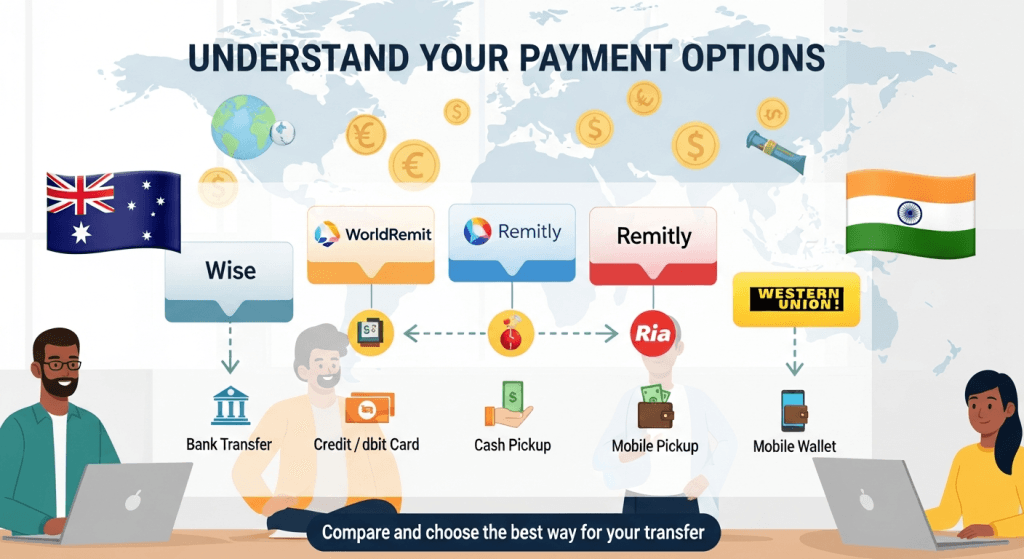
Let's make the options clear. There are pros and cons to each method of sending money from Australia to India. Here's a split based on what I've seen work for other people and what I've done myself:
Transfers between banks.
- Pros: You can trust banks, and their systems are safe. You can move money directly from your Australian account to an Indian account.
- Cons: They can take a long time, sometimes up to four business days. Fees can be high, and exchange rates are usually unfavorable. Some banks charge a fee for sending and receiving money.
Some examples of online money transfer providers are Wise, WorldRemit, Remitly, OFX, Ria, and Western Union.
- Pros: Usually faster than banks (by minutes or hours), with better exchange rates and prices that are easier to understand. Most of them let you check on your transfer at any time.
- Cons: Some services charge more than the exchange rate would suggest. Not all of them work with every Indian bank or payment method.
Mobile Wallets
Paytm, Google Pay, and PhonePe are examples of mobile wallets available to people in India.
- Pros: It's excellent for tech-savvy folks, it's quick to pay off, and it's easy to make little payments.
- Cons: Not everyone who sends money from another country can immediately add to these wallets. People who get the money need to have the wallet app and know how to utilize it.
Getting Money
- Where: India has agents for Ria, Western Union, and MoneyGram.
- Pros: It's suitable for folks who don't have a bank account. Most of the time, it's quick (within minutes).
- Cons:The drawbacks are that the fees are higher and the individual receiving the money must travel to a facility with identification.
Safety and following the rules
In Australia, AUSTRAC laws require providers to verify IDs and monitor transactions for potential fraud. In India, RBI rules say the same thing. This keeps you safe, but it might also slow things down (for example, when you have to upload your ID or answer security questions).
Exchange rates and fees
Don't only look at the cost. When you see "no fee!" but an alarming exchange rate, you'll lose more money than you expect. The total cost is the price plus the difference in the currency rate. Always keep this in mind.
What is the best money transfer service in the UK and Australia?
It depends on the day and the supplier, so here's a direct answer. But I've done the work for you.
Key Players :
- Wise (TransferWise): The rates are always competitive since they use the real mid-market rate, and the costs are transparent.
- TorFX UK: With TorFX UK, you can see the exchange rates, so you know exactly how much will go into your INR account. This is a huge help when the rupee fluctuates.
- WorldRemit offers competitive rates and allows you to receive your money in various ways, including bank deposit, cash pickup, or mobile money transfer.
- Remitly: There are two choices with Remitly: "Economy" (cheaper and slower) and "Express" (faster and more expensive). Suitable for rapid transfers.
- Ria and Western Union: They have a broad reach, but their pricing and fees are subject to frequent changes.
How to Make a Comparison
Suppose you want to send $1,000 AUD to India. This is what I do:
- Go to the calculator for each service provider.
- Enter the money and choose India as the destination.
- Please note that the receiver will receive the entire amount in INR, which includes all applicable fees.
On a recent day, Wise offered ₹55,000, WorldRemit ₹54,800, and Western Union ₹54,200 for the same transfer. What's the difference? Wise had a better exchange rate and lower fixed costs.
Payouts and Speed
Wise and WorldRemit usually deliver in a few hours, and if you pay with a credit card, they might even deliver right away. It could take two to five days for more established banks.
How to Get Better Rates
- Get news about rates. When rates go up, Wise and Remitly will send you an email.
- Send on weekdays. Banks and certain businesses operate more efficiently and may offer better rates during foreign exchange market hours.
- Read the reviews. To determine if transfers are truly delivered on schedule, read recent customer evaluations.
Send money to the WorldRemit account by transferring it from your bank.
I like WorldRemit since it's simple and easy to understand. This is how they do a regular bank transfer:
- Set up Your Transfer: Visit the WorldRemit website or app and select 'India' as your destination.
- Choose a Payment Method: Select "Bank Transfer" as your preferred payment method.
- Get instructions on how to pay: WorldRemit guides on sending money to a bank account in Australia.
Why should you use a bank transfer?
- You keep track of the transaction.
- When you pay with a card, the costs are more than when you pay in cash.
- It's often safer for large amounts because you don't have to worry about card restrictions or extra costs.
Example
Last month, I helped a friend send $700 to his parents in Mumbai. He decided to use WorldRemit's bank transfer option to send money from australia to india. There were no additional costs, and the funds were transferred to his parents' account within two days. He got emails with news at every step. What does he feel bad about? He sent it late on Friday. If he had sent it on Thursday morning, it might have been there even sooner.
Pay with a credit or debit card.
Using a debit or credit card is usually the easiest way to send money from Australia to India if you don't want to wait. This is how it works:
- Visit the money transfer service's website and enter your card information.
- The service charges your card and initiates the transfer immediately.
- Most of the time, the money is transferred to the person within a few minutes to a few hours.
What I Like
- You don't have to wait for the bank to finish processing your payment.
- Suitable for emergencies or last-minute transfers.
- Many places accept Visa and Mastercard, while others accept American Express.
Bad things
- Fees are higher than those for bank transfers.
- Some credit cards treat international transfers like cash advances, charging extra interest or fees. Always verify with your bank.
- Limits on your card may restrict the amount you can send each day.
Advice about safety
- Use only well-known, safe providers.
- Never share your card information outside of the official app or website.
- After each transfer, review your statements to ensure there are no unauthorized charges.
How to Make Money Transfers Go Smoothly
I've messed up. This is what I do today to make sure transfers go smoothly:
- Before you send money, always double-check the recipient's information. A single erroneous digit can send money to the wrong account.
- Before you hit "send," make sure you check the currency rates. A slight modification might make a significant difference when sending money.
- Don't use public Wi-Fi to send money online. Connect to a private, secure network.
- Keep your confirmation emails and receipts. You will need proof if something goes wrong.
- Keep an eye on your transfer until the person you sent it to confirms receipt.
- If you encounter problems, address them promptly. If a transfer is late, don't wait days to call customer service.
In the long run, these practices save me money and worry.
Using analytics to improve your money transfer strategy
If you send money a lot, keep track of your personal information. I keep a simple spreadsheet with the date, the provider, the amount sent, the cost, the conversion rate, the time it took, and the amount received in INR.
What This Means
- Which service providers really give you the best value over time?
- Trends in exchange rates can help you plan your future transfers more effectively.
- How long does it take each supplier to pay out different amounts and in other ways?
This is excellent news for people who sell things. Businesses can enhance their offerings, identify issues, and retain customers by analyzing client transfer data.
Some transfer tools, like Wise, even allow you to download your transfer history. Use this to your advantage.
Final thoughts
When sending money from Australia to India, carefully consider your options to ensure they are safe, inexpensive, and reliable. There are several ways to send money from australia to india, including bank transfers, online services such as Wise and WorldRemit, and mobile wallets like Paytm.
FAQ
How much money can I send online?
Different banks and money transfer services have different limits. Most banks in Australia allow you to send up to $50,000 online; however, certain providers may have other limits. There may be daily, weekly, or monthly limits, especially for new accounts.
What is the safest way to send money to India?
Stick with well-known companies that the Australian government closely monitors. You can trust Wise, Western Union, and banks in your country.
What can I do to lower the costs I have to pay to send money to India?
To ensure you're getting the best deal, always verify the exchange rate and the upfront fee. Some companies claim to have very low costs, but they actually charge more, which means you lose money when you convert. Before choosing a transfer provider, use the online calculators that most of them offer and compare a few options to find the best fit for your needs. Reading the small print and reviews might help you avoid surprises.
Which company has the best exchange rate?
Wise charges a transparent fee that is equal to the genuine mid-market rate. OFX and InstaReM are both very close to winning. Check the live rates, as they can vary every minute. If you shop around, a slight change in the rate can get you more rupees for your dollars.


