

I know how stressful it can be to run a small business. It's hard to keep up with bigger competitors. No one can slow down the market. If you're like me, you already know that gut feelings and messy spreadsheets aren't enough. That's where the best marketing tools for small and medium-sized businesses come in. They are no longer just for big brands; they are the secret weapon for any business that wants to grow with confidence.
When you have to keep track of multiple channels, such as social media, email, your website, and paid ads, your data can quickly become a confusing mess. There is a dashboard for each platform. Not every report looks the same. It's easy to lose sight of what's essential. I've been there, and I know how things change when everything comes together. The best marketing analytics Solutions for SMBs tools help you make decisions that are smarter and faster. These tools consolidate data that is spread out into a single, clear view. They handle tedious reports for you, freeing up hours of your time each week. They help you spot trends and solve problems before they hurt your business. You don't have to be a data scientist or hire a marketing analytics agency to get results. You need the right solution, a little curiosity, and a willingness to use what you learn.
Let's talk about how you can use these platforms to drive real growth—without hype, fluff, or buzzwords.
Top Marketing Analytics Companies
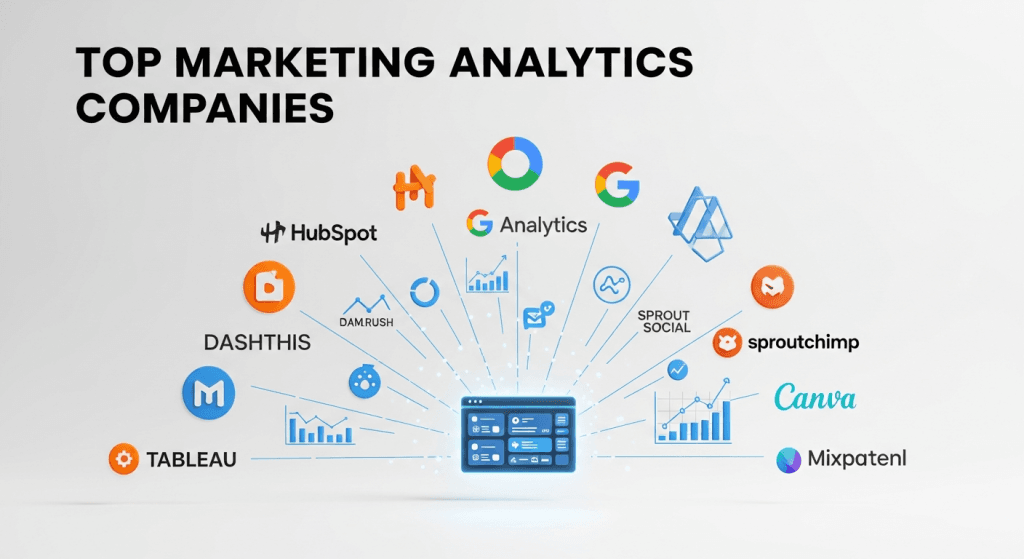
If you've searched for the best marketing analytics solutions for SMBs, you know there's no shortage of options. But which ones actually deliver? Here's my honest review of the top marketing analytics companies, based on real experience and what I've seen work for others.
DashThis
This is a lifesaver for anyone tired of logging into five different platforms to piece together results. With DashThis, all your marketing data—Google Analytics, Facebook Ads, Instagram, Shopify, Mailchimp—lands in a single, clean dashboard. Agencies love it, but it's just as useful for small businesses. The templates are a huge time-saver. You can have a monthly or weekly report up and running in minutes, not hours.
White-labeling is built in, so if you report to clients, you can keep your branding front and centre. For those of us who hate manual exports and spending late nights wrestling with spreadsheets, the automation alone is worth it.
Google Analytics
If you have a website, you should already be using Google Analytics. It gives you deep insights into how people find your site, what Content they spend time on, and where they drop off. The best part? It's free. For analytics for small businesses, it's the go-to starting point. You can track everything from traffic sources to conversion funnels. Many SMBs don't use a fraction of their power. Even at the basic level, it reveals which marketing efforts are paying off.
SEMrush
SEMrush is more than a keyword research tool. It covers SEO, content marketing, PPC, and even competitive intelligence. If you want to know what your competitors are doing or track every detail of your organic search performance, SEMrush is the campaign management tool I'd recommend. You can audit your site, analyze backlinks, and plan your content calendar—all in one place.
HubSpot Marketing Hub
Many small businesses struggle to connect their marketing and sales efforts. That's where HubSpot comes in. It brings email marketing, Content, automation, and CRM together. You get a complete view of your leads from first touch to closed sale, which is why it's among the best inbound marketing tools. HubSpot's integrations save me tons of time and keep my data in sync.
Tableau
If you reach the point where you need to visualize complex data, Tableau steps in. It's a business intelligence tool, not just a marketing dashboard. For businesses that want to delve deeply into trends and patterns across multiple data sources, Tableau is hard to beat. It takes more time to set up, but the insights are worth it.
Maropost, CleverTap, Mixpanel
- Maropost: You can automate and personalize at scale with Maropost, which handles email, push, and SMS campaigns.
- CleverTap: CleverTap is all about getting mobile users to interact. It's great if you depend on an app or a mobile-first audience.
- Mixpanel: Mixpanel examines how people interact with products and how they arrive at those interactions. SaaS and digital product companies that want to keep customers are big fans of it.
What should you be looking for? Easy integrations with your current tools
- Automation to eliminate manual tasks
- Scalability as your needs change
- Transparent pricing that fits your budget
- Coverage of every channel where you find your customers
Consolidation & Automation as Strategy
Let's get real: most of us waste too much time copying data from one platform to another. Every hour spent exporting or merging reports is an hour not spent on strategy. Dash. This changes that. You can get everything you need in one place by automating data aggregation.
It's not just about getting things done faster. You can see the big picture when you put all of your marketing data together instead of just parts of it. We look at all of your paid, email, social, and SEO campaigns at the same time. This method keeps teams from getting bogged down in the details and helps them stay focused on the overall plan.
Decision Support Based on Insight
The best marketing analytics tools for small and medium-sized businesses (SMBs) don't just give you numbers; they also tell you what those numbers mean. For example, DashThis AI Insights shows you what has changed in your data, where you are performing well, and what issues need to be addressed. I love this because it means I don't have to spend hours digging for real answers.
Handling data can be difficult. AI-powered insights show you new chances and sum up the most important points. I don't have to guess anymore; I can make smart choices based on the facts.
Plans for marketing software
I see the most growth in using analytics platforms as active parts of your marketing strategy instead of just passive dashboards. Use templates to get started quickly: Dash. These templates mean you won't waste time making reports. You can focus on analyzing instead of putting things together.
- Share insights with everyone: You don't have to pay for Google Analytics. Let everyone on the team see the exact numbers so they can all learn from them.
- Get the whole funnel: Connect HubSpot to Google Analytics and SEMrush. Now you can see all of your touchpoints in one place, from organic search to email to sales.
- Explore more: If you think you see a hidden trend, use Tableau to make your own charts and graphs to find out what you might be missing. Channel Specific Strategies
Every marketing channel needs its own approach:
- SEO & Content: I utilize SEMrush to research keywords, monitor backlinks, and inform the content strategy. It shows which posts generate traffic—and which ones need improvement.
- Email & Automation: Maropost enables me to create personalized campaigns that are sent out on every channel. Set rules once, and your emails, texts, and push notifications go out automatically.
- Mobile Engagement: CleverTap is my choice for push and SMS messages when it comes to mobile engagement. If you have an app, it's essential to keep users interested by sending them timely reminders.
- Product Behaviour: Mixpanel tells me how people use all of the features. Mixpanel can help you identify where customers are getting stuck or leaving if you're experiencing issues with them dropping off.
Things you can use as ideas and examples
Let's find out what really went down. I assisted a small business that utilized DashThis to simplify their weekly reports. They used to spend 8 to 10 hours a week gathering data from various sources, updating spreadsheets, and sending reports via email. It took less than an hour a week to make those reports after switching to DashThis. They used the extra time to test new campaigns, refine their messages, and generate more creative ideas.
We used Google Analytics to watch how many people went from social ads to the checkout page. We found one source of traffic that had a high bounce rate but few conversions. They redirected funds from less effective channels to the most effective ones, and their online sales increased by 20% in just three months.
I see these kinds of wins all the time. The best marketing analytics tools for small and medium-sized businesses (SMBs) don't just give you data; they also help you make better plans and grow.
What issues do SMBs have, and how do analytics tools help them fix them?
Let's be honest: small and medium-sized businesses have their own issues:
- Data that is spread out: When your data is in silos, it's easy to miss significant trends. Dashboards like DashThis bring everything together, allowing you to see the big picture.
- Limited Resources: Many small businesses can't afford to hire a full-time analyst or a marketing analytics agency. Tools like Google Analytics (which is free) and DashThis (which offers affordable plans) make it easy for everyone to access high-level information.
- Lack of Analytical Expertise: Not everyone on your team is skilled in data analysis. That's why AI Insights and transparent reporting are essential: they make complex things easy to understand, so that anyone can take action.
Building a Data-Driven Culture in SMBs
The best marketing analytics solutions for SMBs are only as good as the people using them. I always encourage owners to involve everyone in the data conversation: train sales, marketing, and leadership on the core KPIs. When the entire team understands what the metrics mean, you get more buy-in and better results.
Make analytics part of your weekly routine. Review dashboards as a team. Celebrate wins, learn from losses, and adjust your strategy together. The tools can transform your marketing, but only if the culture supports it.
Testing & Experimentation Using Analytics
The best marketing analytics solutions for SMBs make it easy to test new ideas. Use A/B tests to compare headlines, landing pages, or ad creative. Google Analytics and SEMrush both allow you to run these experiments at no additional cost.
When you rely on real data to choose winners, you stop wasting money on guesswork. Over time, these minor improvements accumulate to produce significant results. Future Proofing with Predictive Analytics
If you're ready to take the next step, look for tools with predictive analytics. These features do more than just report—they help you anticipate what might happen next and prepare for it. AI-powered predictive features are now available on some BI platforms, such as advanced versions of Tableau.
This gives small and medium-sized businesses more confidence in their plans. You'll know when to buy more stock, look for signs of early churn, or change how much you spend on marketing before things go wrong.
A framework for deciding which tool to use
This is how I help small and medium-sized businesses (SMBs) choose the best tools for marketing analytics:
- Determine your primary objective: Do you require comprehensive reports? Are you using automation? More understanding?
- Choose a tool that works for you:
- DashThis for simple dashboards and automation
- SEMrush for SEO and content strategy
- HubSpot for CRM and marketing that comes to you
- Tableau for analyzing data on a large scale
- Consider the ease of use, cost, compatibility with other tools, and the quality of support.
- Try it out. Keep track of how much time you save and whether the tips really help you make better choices.
A plan for SMB marketers to follow
You don't have to boil the ocean to get started with analytics. This is how I do it step by step:
- Check your current tools and where your data is stored.
- Pick your primary analytics platform based on your goals.
- Set up dashboards and integrations.
- Use templates to launch quickly.
- Train your team. Share your KPI playbook. Look over your insights once a week. Adjust your campaigns based on the findings.
- As your business grows, consider adding AI-powered or predictive analytics tools to gather more data.
Giving marketers the tools they need to make better decisions
I've seen small businesses change when they go from messy spreadsheets to clear, useful dashboards. The best marketing analytics tools for small and medium-sized enterprises (SMBs) do more than make graphs look nice. They give you time back. They help you make better choices. You don't need to overhaul everything overnight. Start with one tool. Pick one KPI. Build from there. As your confidence and culture grow, layer in more advanced features.
Want to see how the right analytics solution can help your business? Book a free SEO consultation or try a demo of your top-choice analytics tool. Let's build something great, one wise decision at a time.
FAQ
How can I effectively track my marketing ROI?
Set specific goals first, like acquiring more leads or sales. To determine where visitors originate, use tracking links such as UTM codes. Google Analytics can link these visits to specific actions, such as signing up or making a purchase. If you run advertisements, link your Facebook or Google advertisements accounts to see how much money you spent compared to how much you made in sales. Some businesses utilise CRM tools like HubSpot to link marketing campaigns to sales results directly. To find ROI, compare what you spent with what you earned: (Earnings – Costs) / Costs x 100. Watch these numbers and adjust your strategy when something works—or doesn't.
How can analytics improve decision-making?
Analytics eliminate the guesswork in marketing. Real numbers show which ads, blog posts, or social channels get the most interest and results. You can see where your money and time pay off, and when it's time to adjust your approach. Data helps you spot trends, learn what your customers want, and avoid wasting budget on things that don't deliver. Instead of relying on a hunch, you can back up your choices with proof.
What are the most important KPIs for SMBs?
Focus on a few numbers that show real progress. For most small businesses, these include website traffic, bounce rate, conversion rate, cost per lead, customer acquisition cost, customer lifetime value, and return on ad spend. Some add email open and click rates, or social media engagement, if those channels matter to their goals. The key is to select KPIs that align with your business targets, not just track everything because you can.
Do analytics help small businesses?
Yes. Analytics help small businesses make informed decisions about how to allocate their resources, connect with more people, and grow more effectively. You can stop wasting time and money by looking at even the most basic numbers to see what works and what doesn't. It's easy to make decisions based on gut feelings or routines without keeping track of things, which can be expensive. Even if you're starting, data shows you the way.


